Our story
CalTREES Shepherd was started by the Friends of the South Fork Gualala (FoSFG), a group of neighbors who came together in 2020 out of concern over the Bootleg Timber Harvest Plan on the Middle South Fork of the Gualala River. Reading that plan closely, we learned how much of what matters most to our local environment is buried in hundreds of pages of documents, with no real acknowledgement of the inevitable impacts that will occur. We challenged the Bootleg THP in court and stopped it in 2023. We were right: according to Judge DeMeo, the plan hadn't adequately analyzed its impacts on sedimentation, wildlife, cultural resources, or the watershed as a whole. And yet CAL FIRE had approved it anyway.
Since then, FoSFG has submitted comments on logging plans across California: on the North Coast, in the Siskiyous and Shasta area, and in the Sierra Nevada. Doing that by hand, plan by plan, watershed by watershed, revealed the same patterns again and again. Every plan ends with CAL FIRE approval and the public's significant concerns dismissed.
So we built a system to do the analysis on every plan, starting with measuring the long-term cumulative impacts and overall health of our watersheds. With math and real science. It turns out it doesn't add up to sustainability. So we added AI analysis to dig deeper into the facts. And now a public website so that anyone, not just experts, can voice their concerns.
What guides us is simple: a forest is the heart, veins and arteries of a watershed, keeping it alive.
- We judge every plan by the numbers: how much more does it add to everything already logged?
- We show our work: every conclusion we publish comes from public data, peer-reviewed modern research, and a method anyone can read, along with its assumptions and limits.
- Commenting on a logging plan is a right under California law.
- CAL FIRE must answer the significant issues the public raises, and we check that they do (and often they do not).
The technology we're developing helps everyday people take part, as humans who care about the impacts on their local environment, in an otherwise complex and time-consuming process.
See it for yourself
Timelapse satellite images tell the real story. You can see this pattern all over the State's forestlands. Press Play.
Explore more with Google Earth Timelapse
California's devastating recent history of clearcutting and destruction is documented even more clearly on Google Earth Engine. There is no hiding from historical satellite imagery. Take a look.
What these timelapses show clearly is that the policies meant to keep California's forests and watersheds sustainable aren't working. Plan by plan, each harvest was approved as “insignificant.” Taken together, they have devastated our State's natural resources.
Rules that have failed us
Commercial logging on private land in California is governed by the Z'berg-Nejedly Forest Practice Act of 1973 and the Forest Practice Rules adopted under it. The rules for assessing cumulative impacts, the question of what one more plan adds to everything else in a watershed, were written in the early 1990s and have changed little since. In practice:
- Each plan is reviewed on its own, and the cumulative assessment is prepared by the forester working for the landowner who wants to log.
- The review typically looks back only about ten years, while a logged watershed takes many decades to recover.
- There is no numeric limit on how much of a watershed can be cut. In practice, the burden falls on the public to show a problem, within a comment window that closes just ten days after CAL FIRE's final review.
- Exemptions and emergency notices allow large amounts of cutting with no CEQA environmental review at all.
Thirty years of approvals under these rules are what the satellite images show.
Sustainable should mean more, not less
If sustainability is the goal, the test is simple: our forests should hold the same or more living biomass, and the same or more stored water, than they did 30 years ago. That is far from the case. Look at the timelapses above: clearcuts from plans approved decades ago still show bare ground or thin regrowth today. The growth that was supposed to replace what was cut shows up only in harvest projections, not in reality.
Your comment is the one thing that slows a plan down
When a logging plan receives no public comments, it is approved as soon as CAL FIRE's review team recommends it. When anyone comments, CAL FIRE must prepare a written Official Response to the significant issues raised before the plan can be approved. That means sending a public comment will always delay a logging plan, no matter what you say, and it puts the problems on the record. Don't be shy. California needs you today!
A missed chance: AB 2494
In 2026 the Legislature passed Assembly Bill 2494, which would have changed how
California manages its own demonstration state forests, including Jackson Demonstration State Forest in
Mendocino County. It would have moved these public forests away from a commercial-timber mandate toward
watershed health, wildfire and climate resilience, research, and tribal stewardship, while still allowing
logging for research and restoration. It was the right way forward.
In September 2026 Governor Newsom vetoed it.
If our own Governor won't stand up to the timber industry and put
watersheds first on forests the public owns, it's up to the public to speak out.
Forests are made of ... water!
Debates about logging usually center on carbon. Carbon matters: a growing tree pulls carbon dioxide from the air and locks it into wood, and dry wood is roughly 50% carbon by weight. But a living tree is roughly 50% water by weight. For the health of a watershed, the water is the more important half.
A forest is a water-storage and water-cycling system. Roots draw water up from the soil; leaves release it back to the air through evapotranspiration, cooling the land and feeding clouds and rain further inland. On the North Coast, redwood canopies comb moisture out of summer fog, dripping it to the ground when there is no rain at all.1 Shade keeps soils and streams cool, and deep roots hold soil on steep slopes. Over the life of a forest, often centuries, that water is held in the wood, the soil, and the cycle the trees keep running.
When a forest is logged, all of that goes with it. The carbon-locked logs are hauled away and kiln-dried, and the water they held is lost forever. More importantly, the natural processes that kept water cycling in the watershed are gone: in the years after a heavy harvest, rain runs off faster, peak flows and erosion rise, summer flows and fog drip fall, and the ground dries out. The watershed recovery curve we generate is our way of measuring how long it takes to get that system back. For an older forest, it almost certainly underestimates the time.
Age matters. A young, fast-growing stand is thirsty: dense saplings pull large amounts of water from the soil to fuel their growth. Older trees grow more slowly for their size and cycle enormous volumes of water through the system. They shade and cool the ground beneath them and their tall canopies catch fog, so a mature forest gives water back to the watershed.2 Replacing old forest with young plantations doesn't just remove the water stored in the trees; it leaves the watershed with a forest that keeps more of the water for itself, year after year, in the driest part of the year.
Drier forests, bigger fires
In the past decade California, Oregon, Washington, and British Columbia, home to North America's western timber industry, have seen the most destructive wildfire seasons in their recorded history. A hotter climate is a major driver. But how did we get here? Research increasingly points the same way: young, dense, even-aged plantations that replace cut forests tend to burn hotter than older, more complex forests.3,4 A forest that has lost its shade, its moisture, and its mature trees has lost its water. It is primed to burn.
“No impacts”
A Timber Harvest Plan is a long, complex document. But at the end of the day it comes down to the same checkbox. In the cumulative impacts assessment, the forester preparing the plan picks one of three columns, and virtually every plan checks the same one:
From the smallest selection harvest to thousands of acres of clearcuts, the answer is always the same. “No impacts.” Really? We all know logging has environmental impacts: some small, some hidden, some impossible to miss. To claim that none of them is significant, alone or added to everything already cut in the watershed, is simply false. It's a conclusion every plan hides behind.
A plan can run hundreds of pages, much of it spent defending that same conclusion with weak arguments, misleading or conclusory statements, and research that is decades old or funded by the timber industry. Every plan we have read and analyzed has failed to show, in rational terms and beyond doubt, that logging will cause no significant impacts. And yet CAL FIRE approves them anyway.
Notes
- Dawson, T.E. (1998). Fog in the California redwood forest: ecosystem inputs and use by plants. Oecologia 117: 476–485. ↩︎
- In Oregon's H.J. Andrews Experimental Forest, streams draining 34- to 43-year-old Douglas-fir plantations carried about half as much water in summer as streams draining 150- to 500-year-old forests nearby: Perry, T.D. & Jones, J.A. (2017). Summer streamflow deficits from regenerating Douglas-fir forest in the Pacific Northwest, USA. Ecohydrology 10: e1790. In the Coast Range's Alsea watershed, a 40- to 53-year-old plantation ran 50% lower in summer than a neighboring mature forest: Segura, C., et al. (2020). Long-term effects of forest harvesting on summer low flow deficits in the Coast Range of Oregon. Journal of Hydrology 585: 124749. ↩︎
- A study of Oregon's 2013 Douglas Complex fire found that intensively managed plantations burned at higher severity than older forests nearby: Zald, H.S.J. & Dunn, C.J. (2018). Severe fire weather and intensive forest management increase fire severity in a multi-ownership landscape. Ecological Applications 28(4): 1068–1080. ↩︎
- A review of more than 1,500 western fires found the most protected forests burned the least severely: Bradley, C.M., Hanson, C.T. & DellaSala, D.A. (2016). Does increased forest protection correspond to higher fire severity in frequent-fire forests of the western United States? Ecosphere 7(10): e01492. ↩︎
How the system works
Every night we pull the latest Timber Harvest Plans from CAL FIRE's public GIS data and the CalTrees permitting portal. Each harvest unit's boundary is intersected with California's Interagency Watershed Map (CalWater), so we know exactly how many acres of each type of cutting fall in each small “planning watershed.” We do the same for every earlier plan on record, back to 1997, when GIS record-keeping began. That history is what makes the analysis cumulative.
1. Cumulative effects: Equivalent Clearcut Area (ECA)
Different kinds of logging remove different amounts of canopy. To add them up on a common scale, each acre is converted to an equivalent clearcut area using a multiplier for how much of the forest canopy is removed:
| Silviculture | ECA multiplier |
|---|---|
| Clearcut | 1.0 |
| Group selection | 0.75 |
| Selection / commercial thinning | 0.5 |
| No harvest | 0.0 |
Cumulative ECA % = ECA acres ÷ watershed acres × 100
We compare the result against two benchmarks widely used in the watershed literature: about 20% unrecovered ECA, where measurable changes in peak flows and channel conditions become likely, and about 30% cumulative ECA, associated with impaired watersheds. These are modeling conventions from research, not legal limits. California's Forest Practice Rules set no percentage at all.
2. Watershed recovery over time
A logged area doesn't stay at full impact forever; as a new forest grows back, its water use and canopy recover. We model each harvest's impact as declining in a straight line from its full ECA value to zero over a recovery period that depends on how heavily it was cut and on forest type:
- Clearcut: 80 years in coast redwood forests (CAL FIRE's Coast region), 60 years in mixed conifer
- Group selection: 50 years
- Selection / thinning: 35 years
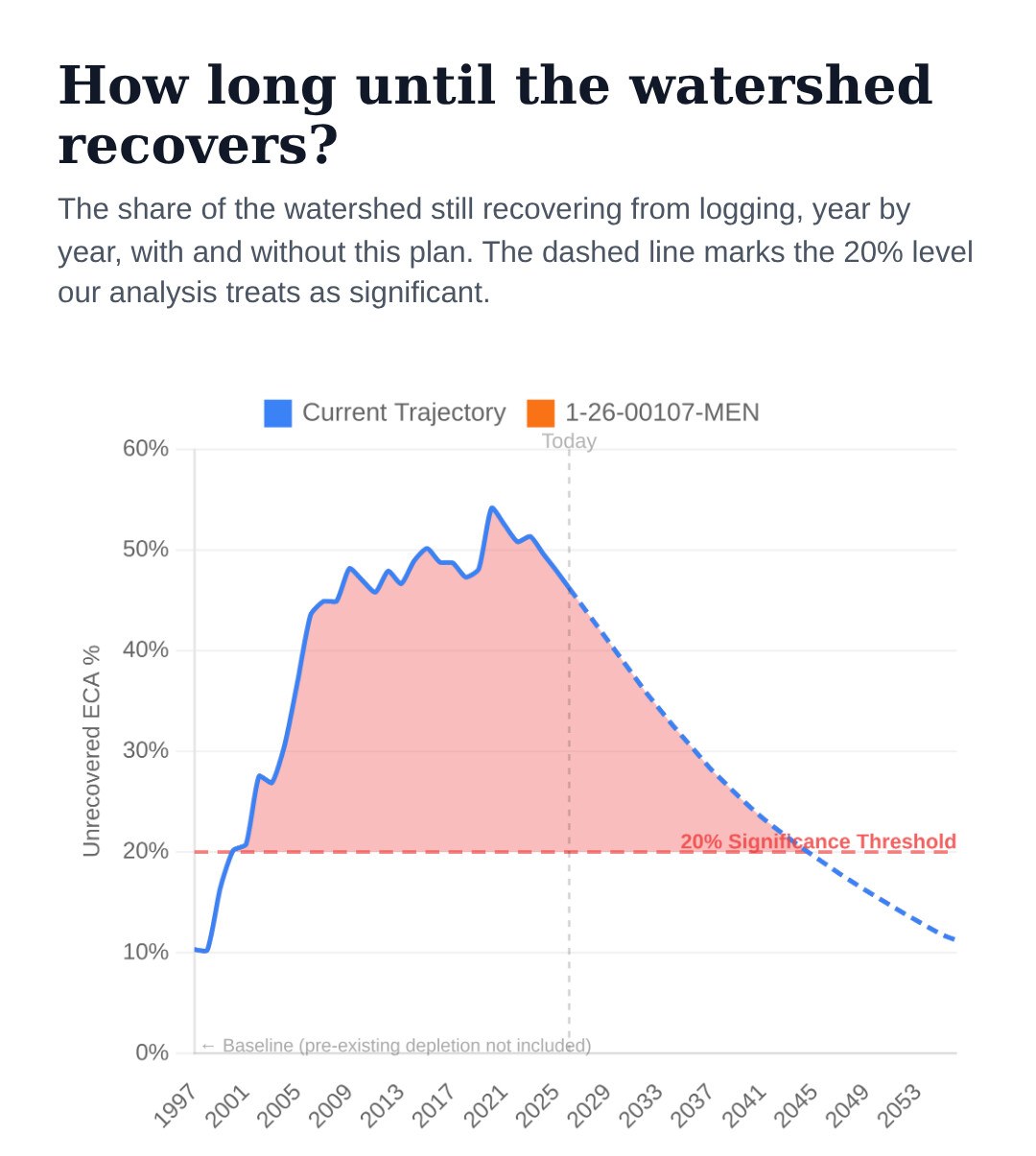
Summing every plan in the watershed, past and proposed, gives a curve of unrecovered impact over time, and shows what a new plan adds on top of what the land is still recovering from. We also translate unrecovered acres into a lost-evapotranspiration estimate (water the forest would have cycled back to the air), using roughly 3.0 acre-feet per acre per year for coast redwood1,2 and 1.25 for Sierra mixed conifer.3
3. Biomass simulation
To show what logging does to the amount of living forest, we simulate a watershed acre by acre, tree by tree, through every plan in its history, and compare it with the same watershed left uncut.
- Starting forest: each acre begins as a mature stand of about 27 large trees (15 at 100 years old and 12 at 110).
- Selection harvest leaves 17 of those trees; clearcut leaves none and the acre restarts as young forest; group selection is treated as half of each.
- Growth: each tree's diameter follows a growth curve that is fast when young and levels off with age:
DBH (cm) = 300 × (1 − e−0.01 × age)²
- Mass: diameter is converted to dry above-ground biomass with a standard log-log allometric equation:
biomass (kg) = exp(−2.6327 + 2.4757 × ln DBH)
- Natural thinning: as stands age, trees die from competition, modeled as a power law:
N(t) = N₀ × ((age + t) ÷ age)−0.7
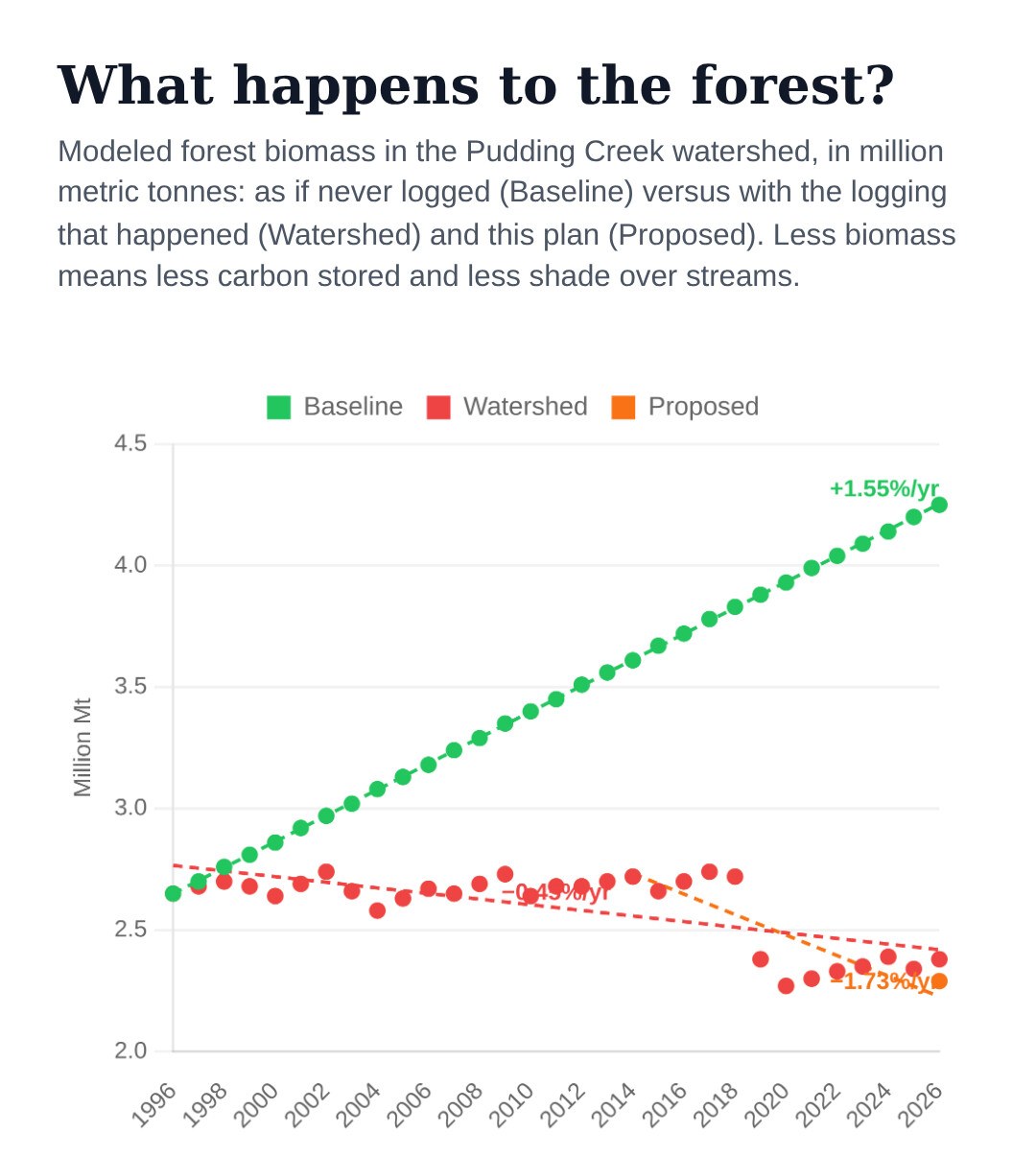
The output, in millions of metric tonnes, is charted year by year: the forest as it would have been, against the forest as it is.
Assumptions and limits
- Harvest boundaries and silviculture come from CAL FIRE's own filings; we don't verify what happened on the ground.
- Recovery periods and multipliers are simplifications. Real recovery depends on site, species, replanting, herbicide use, and roads, which add impact our model doesn't count.
- The biomass model uses one idealized stand for every acre, with far fewer trees per acre than a real forest, and it assumes cut areas regrow on schedule, which the satellite record shows often isn't true. Its absolute totals aren't estimates of real tonnage. It's built for comparison: the shape of the curve in a watershed, and the difference between logging and not logging.
- Exemption and emergency notices, which bypass the THP process, are tracked separately and added where we have data.
Notes
- Dawson, T.E. (1998). Fog in the California redwood forest: ecosystem inputs and use by plants. Oecologia 117: 476–485. ↩︎
- Ewing, H.A., et al. (2009). Fog water and ecosystem function: heterogeneity in a California redwood forest. Ecosystems 12: 417–433. ↩︎
- Goulden, M.L., et al. (2012). Evapotranspiration along an elevation gradient in California's Sierra Nevada. Journal of Geophysical Research: Biogeosciences 117: G03028. ↩︎
How we use AI
A single Timber Harvest Plan can run to well over a thousand pages. We use AI to help analyze and dissect every plan filed in the state, checking it for compliance with the rules.
- Analyzing plans: scanned plan documents are converted to text (OCR software, not AI), then AI-reviewed section by section for watershed, wildlife, road, and cumulative-impact issues.
- Checking the numbers: the watershed figures on this site come from our own GIS calculations and models described in How It Works, not from AI. AI explains them; it doesn't invent them.
- Your public comment letter: on this website, AI helps you turn your own concerns, connection to the place, and words into a draft letter you can edit freely, or replace entirely. AI drafts are based on the same extensive analysis of the THP used by our expert comment letters.
- Our expert comment letters: for the letters CalTREES Shepherd sends under its own name, AI drafts a technical comment from the plan analysis, our watershed data, and a reference library of regulations, court rulings, and published science. That step usually finds mistakes in the plan that CAL FIRE's review team missed. A separate AI verification step then checks the draft against the plan and the data to catch errors and unsupported claims. A person on our team then reviews, edits, signs, and sends it.
Compliance with SB 1159
California's SB 1159 (2026), effective January 1, 2027, makes clear that only natural persons, not AI systems, take part in public processes like CEQA review and public-records requests, and forbids using AI to falsely represent that a person submitted something. People may use AI to help with their own participation, at the scale a person ordinarily would. We built the site around that rule:
- A person sends every letter. Nothing goes to an agency without a human reviewing it and clicking Send. We have no automatic or unattended sending.
- You attest that it's yours. Before sending, you confirm you are the person named, you've read the letter, and you're choosing to send it. We record that attestation.
- Your own name, your own email. Letters are sent only in the name of the person submitting them, never on anyone else's behalf, and an email address is required.
- Ordinary volume. Each person can send a few letters per plan per day, enough to correct a letter or raise a new concern, not enough to flood an agency.
- Disclosure on our expert letters. Letters CalTREES Shepherd sends under its own name state that AI tools assisted with review, analysis, and drafting.